Quiet on Set, Please
Movies, TV, and Independent Films in Southern Oregon
Story by Lynn Leissler
For decades, Hollywood filmed movies, scenes, and TV shows in various Oregon locations, with Central and Eastern Oregon offering ideal Western backdrops.
Southern Oregon has also seen its fair share of actors, sets, and film crews, often highlighting the region’s natural beauty and rugged landscapes—the Rogue River, Hellgate Canyon, our majestic forests. The Great Northfield Minnesota Raid (1972, filmed partly in Jacksonville); Rooster Cogburn (1975, scenes shot in the Rogue River area); The River Wild (1994, filmed on the Rogue River); Wild (2014, scenes on the Pacific Crest Trail, at Crater Lake, in Ashland). TV shows Route 66 (in the 60s) and Gunsmoke (in the 60s/70s) filmed episodes and scenes in the area. Tracker (2024-present) filmed part of its first season in Klamath Falls.
Our region is consistently recognized and awarded for its contributions to moviemaking as a production destination and an educational hub. For the twelfth time, MovieMaker Magazine ranked Ashland as one of the top ten small towns/cities to live and work in as a moviemaker.
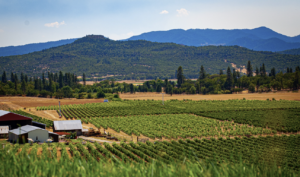
According to a 2025 poll by travel agency Exoticca, Jacksonville was voted the #1 Oregon town for a Hallmark movie setting and recognized as a top 2026 travel destination for its “Hallmark-ready” charm. That charm shows in preserved picturesque, historic downtown buildings and a long-standing traditional Victorian Christmas celebration with tree lighting, a parade, and trolley rides to view festive lights. Year round, Jacksonville offers a cozy small-town feel, nearby wineries and tasting rooms, and photogenic vistas of vineyards, mountains, and farms.
Ashland was recognized in the same survey, credited as “straight out of a movie,” another “Hallmark-ready” town gaining national attention for its charming, cinematic atmosphere. It, too, offers a holiday ambiance with its cozy, sometimes snow-dusted streets, and abundant twinkling lights, its picturesque setting, plus historic features and nearby people-friendly Lithia Park with hiking paths and gardens.
But, those are the big commercial film companies. Our area boasts its own movie presence through independent film companies and film festivals.
Regional film festivals cover a broad spectrum:
- Ashland Independent Film Festival (AIFF), a five-day festival featuring documentaries, features, and shorts (usually under 40 minutes)
- Klamath Independent Film Festival, at Ross Ragland Theater, focuses on Oregon-produced films, with in-person events and a street party
- Wild & Scenic Film Festival, hosted by KS Wild and Rogue Riverkeeper in Ashland and Grants Pass, features environmental and adventure films, with online viewing options
- Wild Rivers Festival, based in Brookings, is a four-day festival focusing on independent films from around the world with emphasis on Oregon-made, coastal films
- Killer Valley Film Festival, horror and comedy, utilizes online streaming and features local content
- SOU Student Film Festival, hosted by Southern Oregon University’s Film Club, showcases student work
The largest, Ashland Independent Film Festival, has been recognized by MovieMaker Magazine multiple times as one of the “25 Coolest Film Festivals in the World.” 2026 marks its 25th year of bringing audiences and filmmakers together to celebrate the power of story. From humble beginnings, AIFF has grown to an international destination, drawing filmmakers and audiences from around the world. They declare—Independent Film, Bold Ideas, Real Connection, claiming, “We believe independent film is more than entertainment—it’s a catalyst for conversation and change.” This regional multi-day event traditionally runs in the spring. Films show at several locations, with downtown Varsity Theatre the central viewing site. They also produce cultural and educational programs for more than 10,000 patrons annually, with screenings in Ashland and rural locations. Someone described AIFF “like Sundance only warmer.”
Fun Notes: Past AIFF’s special guests include, among others, Ty Burrell, Chris Cooper, Will Vinton (Claymation pioneer). AIFF featured Helen Hunt’s directorial debut film, Then She Found Me, (2008), which she also wrote and starred in. This past February, Medford’s Holly Theatre premiered Ernie & Emma, a comedy film which Bruce Campbell produced, directed, and starred in.
Although this year’s festival is over, mark your 2027 calendar. (Southern Oregon Film Society is the organization behind AIFF.)
Baylee Toney
Independent filmmaker, producer, and actor Baylee Toney was born in Ashland and raised in our region. Dancing with the Rogue Ballet sparked her love of performing. She attended Oregon Institute of Technology on a full basketball scholarship, and post-graduation relocated to New York City to pursue a career in acting. Various pursuits led her to fall in love with the western genre. It was that love that propelled her from New York to go west and capture the western vibe in true location.
When she saw the movie Wind River, which touched on a topic rarely dealt with—missing and murdered indigenous women—it caught her attention and led to research, including stories in Oregon. The seeds were sown for Last Tour Home, five years in the making. She and her fiancé, Myles Clohessy, co-wrote the script, which she directed. The film tells the story of a war veteran taking a ranch job to escape his past and the unearthing of secrets and suspicions surrounding an indigenous woman’s unsolved death. The film is on Amazon and Apple TV.
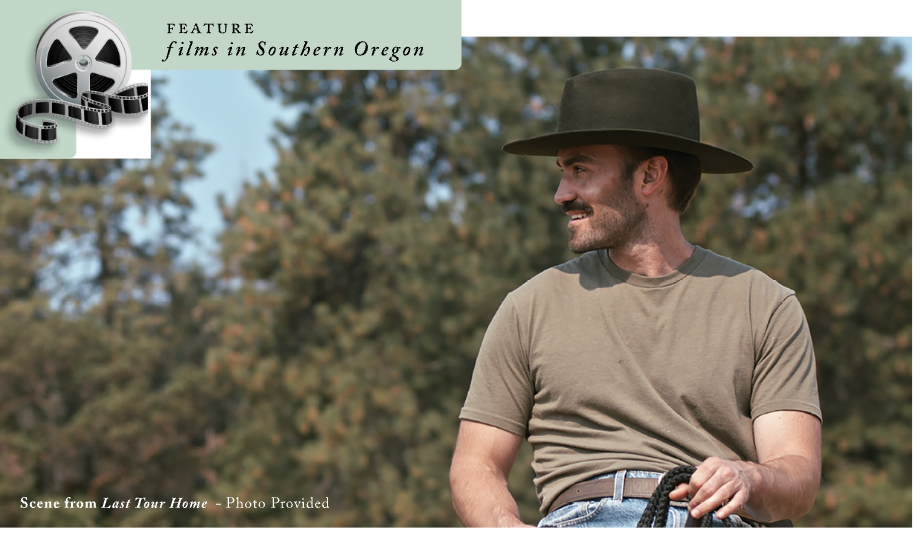
Baylee currently lives in Texas, but Southern Oregon continues to captivate her heart. For her, the region offered the perfect setting and she knew she wanted to film here.
Timber Lands, another of her films set locally, addresses the relationship between the timber industry and local tribes. This film stars two indigenous actors—Wes Studi (Dances with Wolves 1990 and The Last of the Mohicans 1992) and Irene Bedard (the voice of Pocahontas in the 1995 Disney animated film of that name). In Timber Lands Baylee displays her expert-level horseback riding as a barrel racer. They hope for a late summer premier in Southern Oregon. Stay tuned.
When asked why she focuses on the negative, Baylee says that is not her intent, but rather to showcase forgotten people and pieces of our country’s complex history. “Good people do bad things, and bad people do good things.” She believes all our stories need to be told. “Filming these two projects in Southern Oregon brought beauty and joy to a lot of people. I want to do more films in Southern Oregon.” On a side note, she’s heard of people so impressed with the region’s beauty through film, they ended up relocating here. The power of film.
IG is @bayleetoney.clo
Joma Films
Joma Films, founded by Gary and Annie Lundgren, is an independent film production and distribution company based in Ashland. They focus on locally produced, community-driven films, and also operate an indie steaming platform. Gary Lundgren, writer, director, editor, creates thoughtful, character-driven stories, hands-on productions.
I asked Annie the significance of the name. She smiled as she talked about Gary’s grandfather, Joy, and her grandmother, Mae. Combining the two into the company’s name is an honoring of two people whose lives were not easy, but who put in the hard work to go beyond surviving to thriving. They continue to be an inspiration for the Lundgrens.
Annie and Gary started making films together 30 years ago. In 2007, they briefly ventured from Los Angeles to make Calvin Marshall (their first film screened at AIFF) because they had made Wow & Flutter (a 17-minute short) here in 2004 and were familiar with the area, plus they had family here. (A mom brag—one of my sons played in a band that created part of the soundtrack for Calvin Marshall.) In 2010, when their daughter was four, they relocated to Southern Oregon permanently to raise their family. They have since made four films screened at AIFF: Redwood Highway, Phoenix, Oregon (a 2019 feature length film shown online that shared its profits with Covid-shuttered movie theaters and film festivals), Above the Trees, and a 17-minute sneak peek of Pelican (2025, currently in post-production and expected to release at the end of this year or early 2027). Black Road (2016) was filmed here, but released in Los Angeles.
An idea currently brewing is a project about Thomas Merton. (You might have to google the name to learn about this American Trappist monk from the last century.)
Gary is usually the one with ideas. Sometimes people approach him with the classic, “You should do a film about…” but more often it’s a story inside him that he wants to tell.
The Lundgrens recently launched a software company, a new indie form of distribution. The platform allows indies to partner with others. It is filmmaker driven, curator amplified, fan supported, and allows filmmakers to share revenues automatically with partners who promote and support their films.
“Independent filmmaking is a labor of love for anyone in the industry. I want to remind people how important it is to support the arts, to support filmmaking. To make sure independent filmmakers survive.”
Joma’s films can be viewed on www.joma.film and other platforms.
Ray Nomoto Robison
Ray Nomoto Robison was a Fine Arts major at the University of Montana before switching to Montana State University in Bozeman for its film program. After graduation, he headed to Los Angeles. In pretty much a U-turn, he looped from Montana to Hollywood back to Montana, where he held various media-related jobs before moving to Oregon. Here he signed on with a Southern Oregon television station for 20 years of producing and directing ads. In his off time, he began making micro-budget features and short films rooted in the Pacific Northwest, especially using Rogue Valley casts and crews.
His 2006 film noir, Sixes and the One Eyed King, was his first film festival screening. Over his 35-year career, he has produced and directed dozens of films.
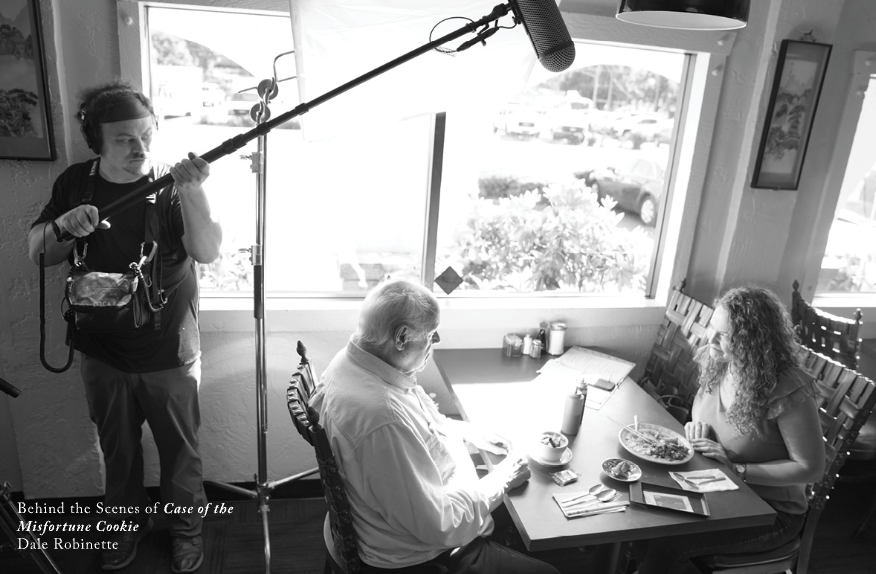
I met him during production of his upcoming short film, Case of the Misfortune Cookie. My initial request for an interview morphed into something bigger and better—an up-close view of scenes shot at The China Hut in Medford. In the end, I got to be an extra. What fun!
The cast and crew included a broad range—one just out of high school, one retired military officer deciding to give acting a go, one who had taken serious lessons to perfect her skill, a few with Hollywood ties, some working to dive deeper in their trade. Assistant director, Scott Ford, is a seasoned acting professional (and a seasonal Santa).
Producing a film, whether a short or a feature-length film, requires patience. Sometimes it’s a total rethinking—how about this—at other times it’s the director saying, “Bring the glass closer. Closer. To the left.” Or, “I like that shoulder shrug. Do it again and walk slower.” It’s all in the details, the angle of the shot, the eyes, the props. The lack of super egos was notable. When a cameraman showed the scene just shot and asked, “Do you guys like this look?” Ray calmly, kindly said, “Not really.” After necessary adjustments, filming moved forward smoothly.
At the conclusion of the day’s filming, I sat down with Ray and cast member Marlyn Mason. The two have worked together on at least 15 films. She has 32 films to her credit and 170 TV show appearances. “I’m considered one of the episodic queens of the 60s and 70s.” She loves being known as leading lady in Elvis Presley’s next-to-last film. Talking about her career, she says, “High on my thank you list are the people I’ve met along the way.”
Case of the Misfortune Cookie, an 18-minute short, is due out in late summer. It will be available on various AVOD (Advertising-Based Video on Demand) streaming platforms. KANOPY, a site connected with your local public library, also offers a wide variety of films.
Ray says that his filmmaking isn’t about making money, but about doing something he finds personally rewarding. And he does it well.
Google Ray Nomoto Robison to find venues where his films may be viewed.
Independent filmmaking offers opportunity to many, including local writer/director Walter Haussner. The film: Grudge, a black and white retro film noire. Elements: Two bad guys, the hunted, including pursuit through Eagle Point’s Butte Creek Mill with live country music and two-steppers.
Most independent films are pay-for-view, others are accessible through free streaming platforms. Consider this, however: when you pay a small fee to watch a film, you help support those who created it. While indie costs are chump change compared to Hollywood budgets, they are costs nonetheless.
SIDEBAR:
There are some among us who work in the larger film industry. Dale Robinette, photographer for this article and others in the past, also plies his trade in Hollywood. (He was the subject of a Southern Oregon Magazine article, Spring 2020.) https://online.flipbuilder.com/lqzx/xwnp/mobile/index.html#p=10
He acted in plays, TV movies and series, soap operas, and commercials before turning to his love for photography, and today is a veteran and highly regarded still photographer with over 150 movie credits, including the independent film Donnie Darko (a cult classic), which propelled his career, and The Help. On the La La Land poster, it is his photography that captured Emma Stone and Ryan Gosling mid-step in their dance with LA in the background. And when Greta Gerwig, director of the blockbuster movie Barbie, requested him—he went!