Cliff Creek Cellars
Where a Working Farm, Family Legacy, and Quiet Hospitality Define the Experience
Story by Chris Cook
Photography by David Gibb
North of Medford, the landscape begins to shift. Orchards stretch wider. Fields open into long bands of green and gold. The roads soften into the slower rhythm of the Rogue Valley’s agricultural countryside, where farms still outnumber subdivisions and life feels tied to the land.
By the time you arrive at Cliff Creek Cellars, the transition feels complete. There is no dramatic entrance or sweeping architectural statement demanding attention. Instead, there is something increasingly rare in modern wine country: authenticity.
Vines run alongside hay fields. A barn sits quietly in the distance. Farm equipment remains visible, integrated into daily life rather than hidden away for aesthetics. The property feels lived in, worked, and deeply rooted. Because it is.
“This is a working farm,” says owner Ruth Garvin. “We wanted people to experience wine in the middle of real life—not a staged version of it.” At Cliff Creek, wine is not separated from agriculture. It is part of it. And that distinction shapes everything.
A Vineyard Built on Grit
Long before vines were planted, the land itself carried a history of farming. When Ruth’s father, Vern Garvin, purchased the property in the early 1990s, he wasn’t looking for retirement. At 70 years old and inspired by the early momentum of Southern Oregon wine, he planted grapes instead. “He wasn’t someone who was going to sit still and play golf,” Ruth says. The vineyard was planted in 2000, with the first commercial harvest following in 2003.
Today, the estate spans more than 200 acres, with vineyards woven naturally into hay production and open farmland—a coexistence that feels increasingly uncommon in wine regions built more around tourism than agriculture.
“You’re not separated from the farm here,” Ruth explains. “If we’re working, you’ll see it. If something’s happening in the vineyard, you’re part of it.” That transparency creates an immediate sense of honesty. There is no attempt to romanticize farming while concealing the realities of it. Cliff Creek embraces the beauty of agricultural life—the seasons, the labor, the unpredictability. And for visitors increasingly drawn to genuine experiences over curated ones, that authenticity resonates.
A Different Kind of Wine Country Experience
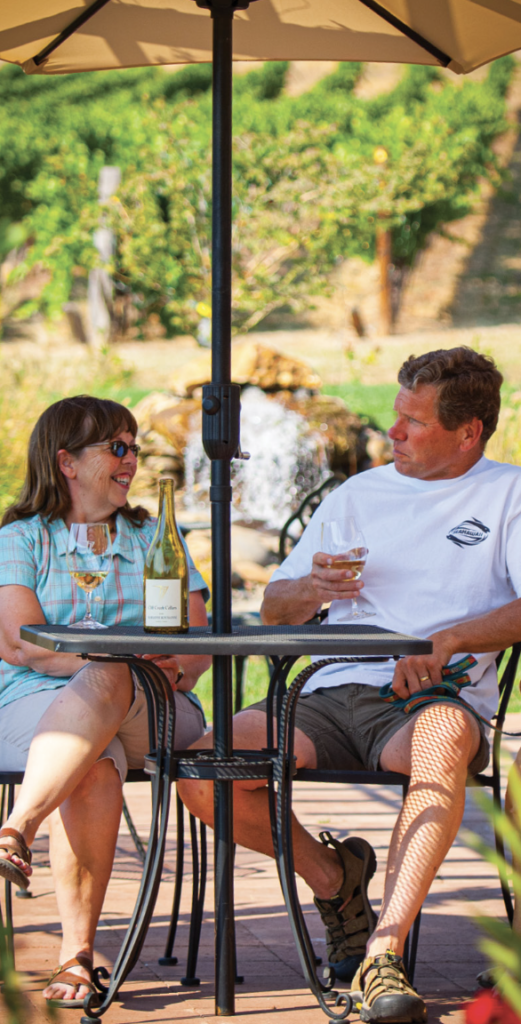
At a time when many wineries are expanding into entertainment venues with packed calendars and large-scale events, Cliff Creek has intentionally chosen another path. The focus here is not on filling every moment. It is on creating space. Guests arrive with picnic baskets. Tastings become bottles shared slowly across an afternoon. Conversations stretch longer than expected.
“The goal is that people come out, relax, and just enjoy being here.”
Hospitality at Cliff Creek is warm but never intrusive. Guests are welcomed naturally, then given room to settle into the experience at their own pace. That atmosphere encourages something increasingly uncommon: lingering. And that feeling—of slowing down—is exactly what keeps many guests returning.
Letting the Land Stay Honest
Part of what defines Cliff Creek is not what has been added, but what has been intentionally left untouched. The agricultural character of the property has not been polished away in pursuit of a luxury wine aesthetic. The barn remains part of the landscape. Equipment stays where it is needed. The vineyard is accessible, but respected. During bloom season, guests are gently asked not to walk through the vines. “That’s a sacred time,” Ruth explains. “The blooms are so delicate you might not even notice them. I tell people it’s like a dandelion—if you brush against it, you can disrupt everything.” It is a small detail, but one that reflects the winery’s larger philosophy. This is not simply a backdrop for wine tasting. It is a living agricultural environment.
Southern Oregon Heads North
Cliff Creek Cellars was among a small group of Southern Oregon wineries that ventured north in the early 2000s to showcase what the region was capable of producing. In 2008, the winery opened its first tasting room in Carlton—deep in Pinot Noir country—before relocating to Newberg in 2013 after outgrowing the original space. Housed in the town’s oldest bank building, complete with original vaults and wood-paneled interiors, the tasting room reflects Cliff Creek’s appreciation for history, character, and the idea that age adds depth—both to wine and place. Like the vineyard estate, the Newberg tasting room emphasizes connection, offering thoughtful, table-side pairings, stories about the family and vineyards, and regular showcases of Southern Oregon producers, including events like the Upper Rogue Wine Trail’s annual Roam the Rogue weekend.
Wines Rooted in Balance
Cliff Creek’s wines reflect the same philosophy as the property itself: balance over excess, authenticity over trend. The estate-grown portfolio is shaped by the Rogue Valley’s warm days and cool nights. Rhône and Bordeaux varietals form the backbone of production, including Cabernet Sauvignon, Syrah, Cabernet Franc, Merlot, and Sangiovese.
But Cliff Creek also embraces wines designed simply for enjoyment. “We have what we call our ‘fun wines,’” Ruth says. “Pink Pink, White White, Red Red—those are approachable wines people can just relax and enjoy.” Even within those lighter expressions, the philosophy remains consistent: balanced, food-friendly wines meant to invite another sip.
And for Cliff Creek’s more serious wines, patience matters. “We age our wines longer before release,” Ruth says. “We want people to experience the wine as it’s intended to be—not what it might become someday.” That approach reflects a quiet confidence increasingly associated with mature wine regions: restraint often creates more lasting wines than immediacy.
Smaller Gatherings, Deeper Connection
In recent years, Cliff Creek has expanded its event programming thoughtfully—but always in ways that reflect the winery’s broader identity. Rather than building toward larger events, Ruth has focused on creating experiences that feel personal and immersive. “I’ve done the big dinners with 40 or 50 people,” she says. “But something gets lost. I’d rather have 20 people and make it meaningful.” That philosophy has shaped a growing series of curated gatherings, educational tastings, and wine dinners emphasizing conversation and connection over spectacle.
Among the most popular is the winery’s consistently sold-out “Europe Goes Rogue” dinner series. One evening may center around a lively Italian feast paired with Sangiovese and Super Tuscan blends. Another may explore French cuisine alongside Bordeaux and Rhône varietals. Spanish-inspired dinners showcase the winery’s Tempranillo and Mediterranean-style wines.
The dinners are refined without feeling formal—an extension of the winery itself. “It’s about giving people something to engage with,” Ruth says. “Not just pouring wine.”
The Road Back to Wine
Ruth’s own path back to the vineyard was far from direct. She studied political science before working briefly in television advertising. Later, she moved to Portland and opened a coffee business before coffee culture exploded into mainstream popularity, eventually growing it to four locations. By 2008, she was ready for a change. “We had made our first wines, and someone needed to sell them. I told my parents, ‘If you want me, I’ll come.’”
She sold the coffee business and returned to Southern Oregon, bringing with her a deep understanding of hospitality and customer experience that now quietly shapes Cliff Creek.
Guests are not treated like customers moving through a system. They are treated like visitors welcomed onto a family property. That distinction matters.
The Real Luxury: Space to Breathe
Late in the afternoon, as the light shifts across the valley, the pace at Cliff Creek slows even further. Conversations quiet. Glasses linger half full. The air cools just enough to notice.
Sometimes, if you stay long enough, you might hear it—the low, soft call of a barn owl somewhere beyond the vines. “That’s my favorite,” Ruth says. “Just sitting here with the window open, listening.” It’s a small moment. Easy to miss. But it captures something essential about this place.
Cliff Creek isn’t trying to be everything. It’s offering something simpler—and, for many, something better. A place to sit. To taste. To breathe. And to remember what wine feels like when it’s connected to the land it comes from.
Vineyard Tasting Room
1015 McDonough Rd
Gold Hill
541-855-5330
Newberg Tasting Room
214 E. 1st St
Newberg
503-487-6692